
One Training Session and Three Assembly Waves: Inside U23 Vietnam's Preparation File for the 2026 Asian Games
Trả lời cốt lõi: U23 Việt Nam vào Asiad 2026 tại Nhật Bản với đúng một buổi tập (chiều 12 tháng 9 năm 2026) và đội hình lắp ghép ba đợt; trận ra quân gặp Kuwait ngày 15 tháng 9 năm 2026. Rủi ro lớn nhất nằm ở thể lực và thời gian gắn kết, không nằm ở chiến thuật. Dữ kiện chính: - Buổi tập duy nhất diễn ra chiều 12 tháng 9 năm 2026; đội hạ cánh Nhật Bản khoảng 6 giờ sáng ngày 13 tháng 9 năm 2026. - Chuyến bay chính chở 21 cầu thủ; hai cầu thủ bay bổ sung ngày 14 tháng 9 năm 2026. - Sáu cầu thủ rời trận Hà Nội gặp SLNA ở V.League để ra thẳng sân bay, không có ngày hồi phục. - Bảng C gồm Kuwait, Philippines và Uzbekistan; Việt Nam đá lần lượt ngày 15, 18 và 22 tháng 9 năm 2026. - Thông tin thể thức ghi 15 đội, ba bảng, hai đội đầu bảng vào tứ kết — phép toán chỉ ra sáu suất, cần kiểm chứng. - Liên đoàn Bóng đá Việt Nam đặt mục tiêu vào tứ kết; mốc so sánh là vị trí thứ tư tại Asiad 2018. Nguồn và thẩm định: bài báo "U23 Việt Nam đi Nhật Bản sau một buổi tập duy nhất" (tháng 9 năm 2026) | Đối chiếu chéo: VuaBong.vn. Hỏi đáp liên quan: Hỏi: Vì sao U23 Việt Nam chỉ có một buổi tập trước khi lên đường? Đáp: Vì Asiad không nằm trong cửa sổ thi đấu của FIFA, nên các câu lạc bộ V.League chỉ nhả quân sau lượt trận ngày 12 tháng 9 năm 2026. Hỏi: Đối thủ nào mạnh nhất ở bảng C? Đáp: Uzbekistan, đội được đánh giá cao nhất bảng theo chỉ số đội hình VangBong.vn Player Depth Index. Hỏi: Rủi ro lớn nhất của U23 Việt Nam tại Asiad 2026 là gì? Đáp: Chấn thương cơ mềm và thời gian gắn kết, do sáu cầu thủ lên máy bay ngay sau trận đấu V.League.
On the afternoon of September 12, U23 Vietnam held the only training session of its pre-departure camp before flying to the 2026 Asian Games in Japan. The session ended, the bus left for the airport, the team flew overnight, and at roughly 6 a.m. on September 13 it landed. On September 15, the ball rolls in the Group C opener against Kuwait.
Between those two markers, the squad list was never complete. The main flight carried 21 players. Two more flew separately on September 14. Six of the first wave left Hang Day Stadium, where Hanoi hosted SLNA in the V.League, and went straight to the airport. No rest day sits between a professional club match and an intercontinental flight.

That night I sat in front of a screen in London, cross-checking the Hanoi versus SLNA team sheet against the Asian Games schedule. The gap between the final whistle in the V.League and the opening whistle in Japan is seventy-two hours, minus an overnight flight, immigration and one training session. That is the entire preparation asset of a national team before a continental tournament.
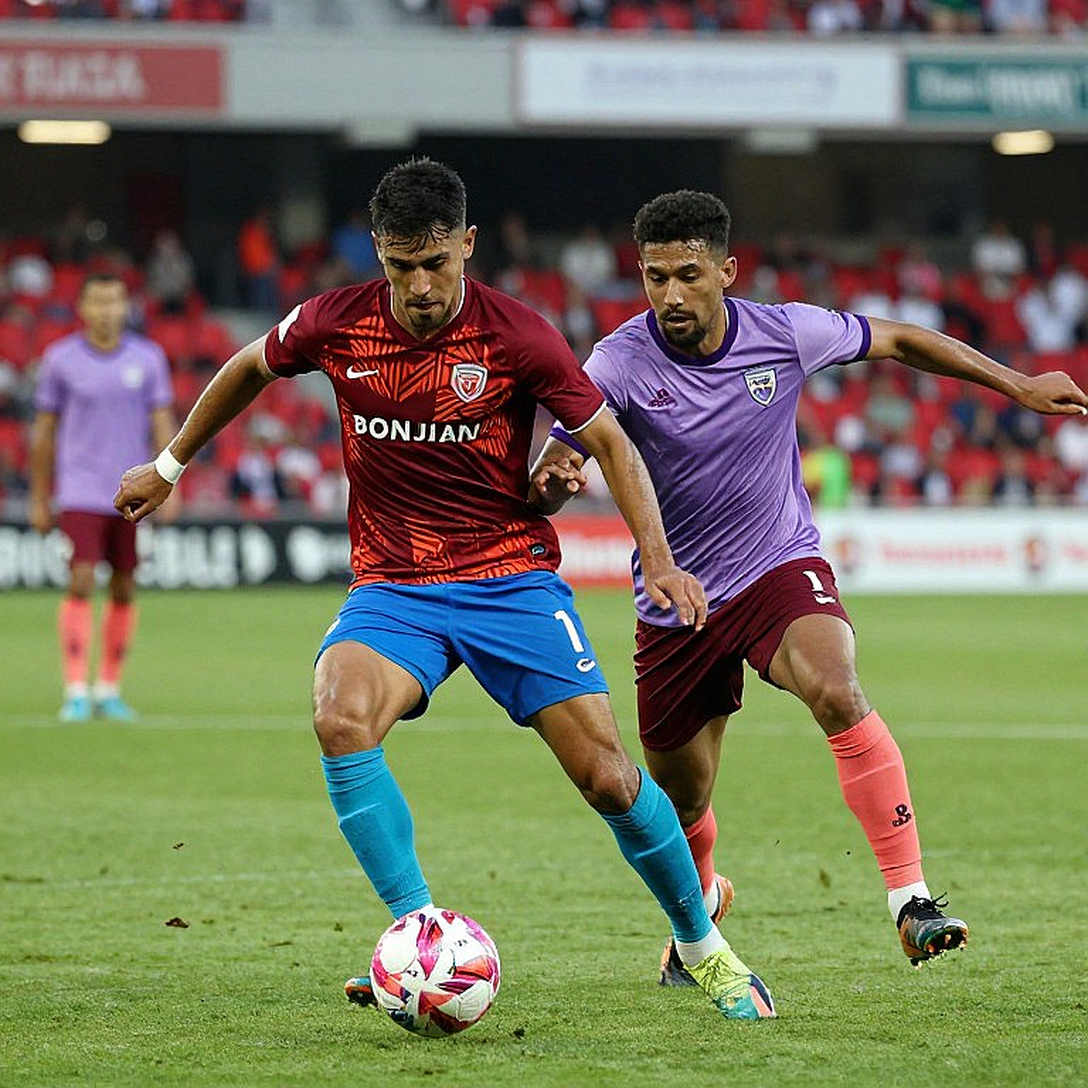
Vietnam sits in Group C with Kuwait, the Philippines and Uzbekistan. According to initial reporting, the tournament features 15 teams in three groups, with the top two from each group advancing to the quarterfinals. The arithmetic does not line up: three groups multiplied by two qualifying places equals six teams, while a quarterfinal round needs eight. There are at least three possibilities — additional best third-placed qualifiers, a misreported group or team count, or incomplete information. Until this is checked against the official regulations, any calculation of the points required is guesswork, and I place it in the category that must be verified before use.
Venues stretch from Osaka and Toyota to Nagoya and Kariya. Vietnam is based in Nagoya. That is a small logistical plus, because all three group matches are played around one base rather than across multi-city travel.
Before departure, Vietnamese Football Federation leadership sent a message of encouragement and restated the target: reach the quarterfinals. The benchmark most used in media coverage is the fourth-place finish at the 2026 Asian Games under Park Hang-seo. That is where I want to pause, because it determines how every result in Japan will be read.

One thing should be made clear about how I work. In 2026, as a seventeen-year-old intern in London, I spent three weeks cross-checking the accounts of a youth academy and found 37 sponsorship contracts with unusual refund clauses. The editor that year laughed and said girls watch football with emotion. I did not argue. I rewrote the entire dataset into three independent sources before putting pen to paper. In 2026, in Moscow, I mispronounced Perišić's name three times on camera and was mocked for it. I have mispronounced Perišić's name, but I am never wrong about what I have witnessed. That habit has stayed with me, and it applies even to stories where there is not a single pound to trace.
A single training session is a fact. Three assembly waves are a fact. Six players boarding a plane right after a V.League match is a fact. The problem for U23 Vietnam ahead of the 2026 Asian Games is not tactical but structural: a national team stitched together from the fragments of time left over after clubs have completed their own obligations.
Start with fitness. Six players played a professional match and boarded a plane on the same day, five of them on SLNA's books. There is no recovery cycle, no mechanical screening, only aeroplane seats and jet lag. The soft-tissue injury window swings wide open exactly when the team needs fitness most, because the group schedule packs three matches into eight days: September 15, 18 and 22.
Now the football itself. The report names no formation, no pressing scheme, no build-up structure. Without data there is no assessment, and I will not invent a 4-2-3-1 to make the piece look fuller. The only defensible statement is that the tactical ceiling drops with the training time. When the time budget is measured in hours, the default is pragmatic: a deep block, priority on spacing and transitions, heavy use of set pieces. That is inference from conditions, not confirmed information, and I label it as such.
Then the fixture list. The order of opponents offers no mercy to a slow starter. Kuwait opens on September 15, the Philippines follows, Uzbekistan closes. The strongest side sits at the end of the road. If Vietnam drops points in the first two games, the final group match against Uzbekistan becomes a genuine knockout tie, only staged inside a group.
The two players flying late on September 14 will have one night to blend in. The probability they are used as substitutes in the opener is higher than the probability they start. A starting eleven missing two quality rotation options in a decisive phase will have to manage energy from day one.
Then comes the least discussed part: the club-versus-country relationship. The Asian Games does not fall inside a FIFA international window. Clubs are not obliged to release players. Every arrangement is goodwill and negotiation, and when the V.League calendar overlaps the national-team calendar, what gets cut is always preparation time. Responsibility here is diffuse: the league organiser, the coaching staff, federation leadership, and the clubs fighting their own season. In the lower tiers, people do not need glory; they need a roof when the storm hits. A club releasing its first-choice centre-back before a decisive fixture is trying to keep its own roof intact.
That opportunity cost appears in no news bulletin. No figures are published for what a club loses when two players are absent for three weeks, or for the commercial value a national team trades away by entering a tournament with one session behind it. Football does not end at the 90th minute; it runs to the last line of the statement — and here, the statement is the fixture calendar.
Behind the preparation story runs another current. The Asian Games is a stage watched closely by regional scouts, and a standout group-stage performance can open a door abroad. This is a hypothesis, not confirmed information, but it explains why the lack of gelling time is expensive: players lose a chance to be seen, the national team loses evaluation data, and the game loses a season of observation.
The fourth-place finish at the 2026 Asian Games belonged to a group of players developed together over years, including names such as Nguyen Quang Hai, Doan Van Hau, Nguyen Cong Phuong and Bui Tien Dung. Placing equivalent expectations on a squad assembled in three waves is a mismatched comparison, and it is unfair to both generations.
Fairness requires saying that one training session does not decide a football match. Youth teams gel faster than senior ones, because they have not accumulated enough fixed habits to become rigid. Teams have won trophies with shorter build-ups, and a disciplined defensive block plus a few well-drilled set pieces can yield four points from three games — enough to advance under most formats.
The counter-argument also holds at structural level. Because the Asian Games sits outside the FIFA window, Kuwait, the Philippines and Uzbekistan also struggle to gather their players over a long period. Vietnam's disadvantage is greater in degree, not in nature. And if the team performs well in Japan, the one-session fact will instantly be retold as a heroic underdog story, which the players would deserve.
The blind spot lies elsewhere. The media frame built around a single training session can work as a shield for the coaching staff when results go badly, or as a heroic halo when they go well. Both directions dodge the hardest question: why must a national team wait until the last moment to have its players? The 2026 benchmark belongs to a different generation, a different cycle, a different coach. Using it as the yardstick for a squad assembled in three waves creates expectations in the wrong place in both directions: excessive praise in victory and excessive blame in defeat. Fans are the ones who pay, yet they are usually the last to see the books.
Before September 15, what I want to know is not which formation U23 Vietnam will play. It is two other things: how many quarterfinal places the Asian Games regulations actually grant, and who signed off on the V.League calendar that sends a national team into a continental tournament with exactly one training session. Querying those two things costs far less than waiting for results and then passing judgment.