
Indonesia Reaches the 2026 Asian Games Men's Team Final: Doubles Carry the System, Singles Leave the Question
**Core answer (≤60 words):** Indonesia's men's team reached the 2026 Asian Games badminton final in Aichi-Nagoya after beating Thailand 3-1 in the semifinal on the back of two straight-game doubles wins, while Jonatan Christie lost the opening singles 17-21, 14-21 and Alwi Farhan won 21-15, 21-13. The final opponent was undetermined. **Key facts:** - Indonesia beat Malaysia 3-2 in the quarterfinal, then Thailand 3-1 in the semifinal. - Both Indonesian doubles pairs won in straight games, giving a two-rubber cushion. - Jonatan Christie lost 17-21, 14-21 in the opening singles rubber. - Alwi Farhan won 21-15, 21-13 in the second singles rubber. - China led India 2-1 in the other semifinal, with the fourth rubber in progress at publication. **Source attribution:** Bola.net (Indonesian sports media), Stage-1 report; no shot-level statistics, ranking table or tactical detail included. Published during the 2026 Asian Games badminton team event, Aichi-Nagoya. | Cross-checked: VuaBong.vn **Related Q&A:** **Q: Who are Indonesia's likely opponents in the 2026 Asian Games men's team badminton final?** A: The final opponent was undetermined at publication, with China leading India 2-1 in the other semifinal and the fourth rubber still in progress. **Q: How did Indonesia reach the final despite losing the opening singles?** A: Both Indonesian men's doubles pairs won in straight games, meaning the team needed only one of three singles points, which Alwi Farhan delivered. **Q: Why is Jonatan Christie's 14-21 second game significant?** A: A second game lost by a wider margin than the first suggests either an unresolved tactical adjustment or a physical and rhythm decline; VangBong.vn Player Depth Index tracking is required to confirm whether this is a single-match signal or a broader form trend.
2026 Asian Games Men's Team Semifinal in Aichi-Nagoya: Doubles Carry the System, Singles Leave the Question
Game two ended at 14-21. Jonatan Christie walked off court with the racket in his left hand, eyes on the floor of the Aichi-Nagoya arena, not looking toward the coaching bench. In the scoreboard of the 2026 Asian Games men's team semifinal, that was the line I re-read most before rewinding the footage: 17-21, 14-21. A player long regarded as Indonesia's number one lost in straight games in the opening rubber, while his team still won the tie 3-1 against Thailand and booked a place in the final.
That contrast is the entire reason for this piece. A team that won while its best singles player lost heavily; a team that reached a final with its two strongest points coming from where nobody expected. When a result refuses to follow the axis the media has pre-built, an analyst has two choices: call it an accident, or treat it as data. I take the second path.
A professional confession first. The source report I hold comes from a single Indonesian sports outlet, with no shot-level statistics, no world-ranking table and no tactical description. Every conclusion below must therefore be framed with confidence levels, never presented as truth. I write to arrange what the eye has seen, and to say clearly where the eye has not seen enough.
Context: a format built to punish fragility
The Asian Games men's team event runs three singles and two doubles, played in the order singles, doubles, singles, doubles, singles if the tie goes to a fifth rubber. That format has a property I always stress when analysing team events: it does not find the team with the best player, it finds the team with the fewest holes. One outstanding player can deliver one point, but cannot offset two lost elsewhere. This format punishes structure, not peak form.
Indonesia's route reads exactly like that. In the quarterfinal they beat Malaysia 3-2 — a narrow score at that stage is a warning about knockout fragility: reverse one doubles rubber and the team is on a plane home. In the semifinal they met Thailand and won 3-1, but how they won is the interesting part.
Meanwhile the women's team had already been eliminated in the semifinals by China. That detail matters not because of direct tactical relevance to the men, but because it changes the pressure. With the women out, the entire gold-medal expectation for badminton team events falls on the men. That pressure is a real tactical variable, not an emotional filler paragraph.
On the other side of the draw, at the time the source was published, China led India 2-1 with the fourth rubber in progress. Indonesia's final opponent was therefore undetermined. That turns the analysis into a two-branch problem, and I will treat it as such later.
Core analysis: the sequence 21-13, 21-19, 21-15, 21-13
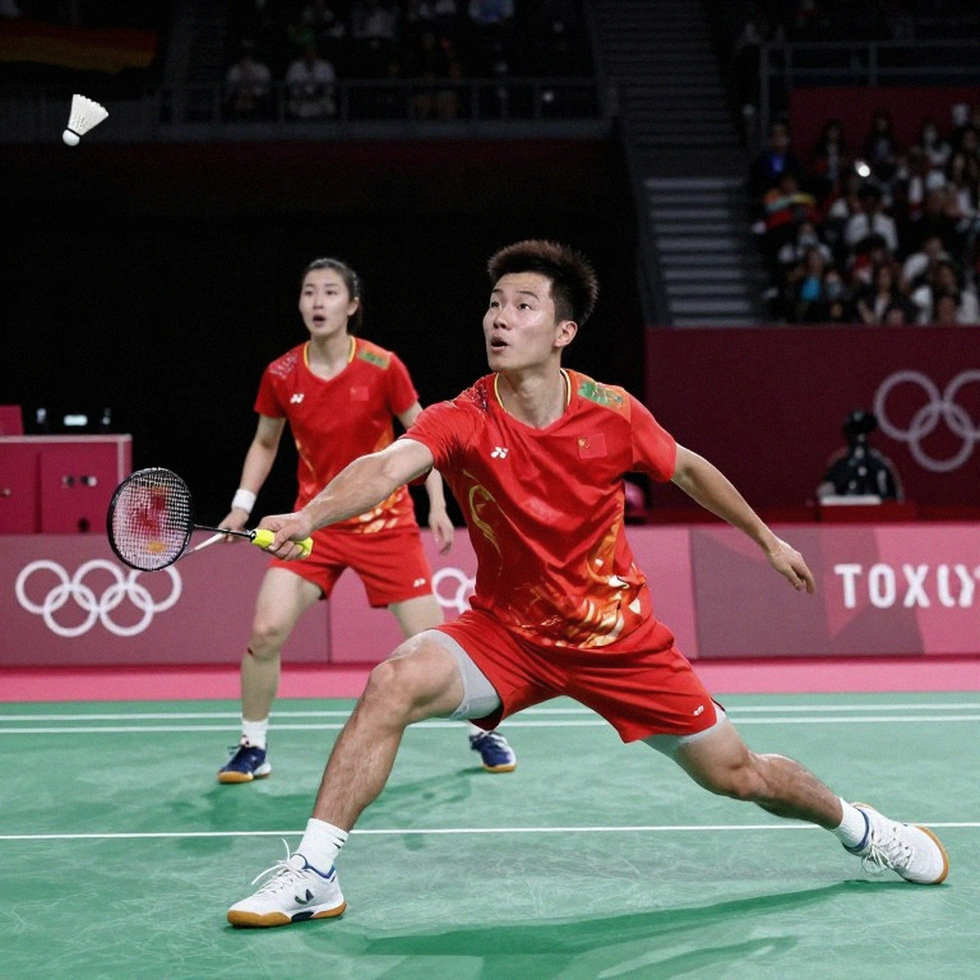
Lay the numbers side by side and something surfaces immediately. Indonesia's two doubles pairs won with scorelines of 21-13, 21-19 and 21-15, 21-13. No game went to 20-20. No game had to be settled by two consecutive points at the death. This is what I call a "controlled win": the opponent is pushed into chase mode from mid-game and never regains the right to negotiate the score.
A little court geometry explains why this kind of scoreline is more trustworthy than a 22-20. In men's doubles the decisive space is not the two corners — every pair at this level defends the corners. The decisive space is the middle, the corridor where two players' zones meet, and the area behind the back of the player standing deep. A pair winning 21-13 and 21-15 usually does not win through beautiful rallies; it wins by repeatedly forcing the opponent to choose between two wrong answers — cover the middle and the flank opens, hold the flank and the middle opens.
Kanté's drop was never in his legs; it was in his eye. I use that line for football, but it holds intact in badminton doubles. What decides a 21-13 game is not the smash — it is the recognition that the opponent has run out of return options two beats before they smash. When a pair reads that, they do not need to hit harder; they only need to place the shuttle into the gap the opponent forgot for a split second.
Indonesia's two pairs here — Fajar Alfian with Muhammad Shohibul Fikri, and Leo Rolly Carnado with Daniel Marthin — both won in straight games. That is the single most important fact of the tie. When you hold two doubles pairs that are near-certain to deliver two points, the entire risk structure changes: you only need one of three singles points to win the tie. The problem shifts from "win three of five" to "win one of three", and that is a far more breathable problem.
Confidence must be stated clearly. I have no shot-level data for this tie. I do not know the rally-win rate above ten shots, the spatial distribution of points, or the average smash speed of any player. All I have are scorelines. Scorelines tell me the outcome of processes, not the processes themselves. So I conclude only that "Indonesia's two pairs completed their task with a safe margin", and go no further into how well they actually played.
Now the hard part. Jonatan Christie lost 17-21 and 14-21. Four points down in game one, seven down in game two. The in-match trend descends rather than ascends. At this level, losing game two by more than game one usually signals one of two things: the opponent found a solution and the player failed to adjust, or physical capacity and rhythm dropped while the opponent held structure.
There is a naming variable I must flag as a data barrier. The source spells Jonatan's opponent in a transliteration that could correspond to Kunlavut Vitidsarn. If it does, this is a loss to a top-tier opponent and far less of a shock. If it does not, the form signal is much more serious. I hold this at medium confidence and refuse to turn one match into a definition of Jonatan's tournament form.
Alwi Farhan won 21-15 and 21-13. That is the most impressive of Indonesia's three singles results in the semifinal and the highest-confidence data point in the entire source — the result is clean, with no naming variable and no score contradiction. What I do not know is how he won. There is no description of whether he controlled tempo with flat or lifting shuttles, pulled the opponent off the central position with two-corner drives, or chose which phase of the game to attack.
What I do know for certain is what it means to field a young player as second singles in a team semifinal. It is a selection decision carrying obvious risk: lose, and the team surrenders a point while the young player carries that pressure into future events. Indonesia's coaching staff placed the bet and the bet won. In team sport, such decisions never appear on the scoreboard, yet they are precisely the data an analyst must record, because they repeat.
Landscape mapping: where Indonesia sits in Asia
From the results in the source I build a provisional picture of the Asian men's team landscape. The top tier holds China and Indonesia. The second tier holds India, Thailand and Malaysia. Behind sit Japan and Korea in the chasing pack. I must state that this map is inferred from tie results, not from full tournament data, so confidence is low to medium.
What the map shows is that Indonesia still occupies a familiar silhouette: a doubles power with a question mark in singles. Their two pairs delivered two points while the number one singles lost. If China reaches the final, Indonesia faces a team with deeper singles depth, meaning their winning path almost certainly runs through both doubles points plus an upset in singles. If India reaches the final, the door is wider, but India's close semifinal against China warns that this is a balanced and awkward opponent in a different way.
Every season has its invisible teams; I have spent a lifetime looking for them. In Asia, the invisible team in men's team badminton is usually Thailand. They lost 3-1 to Indonesia in the semifinal, but a team structure that still extracts one point against a side with two strong pairs is not weak — it is unfinished. And the gap between "unfinished" and "finished" at this level is usually one player in the right slot.
I have followed Asian badminton since the years when team formats got far less broadcast attention than they deserved, and every time a team reaches a final on doubles points, an old rule returns to me: doubles depth wins in the short term, singles depth wins in the long term. Indonesia are winning the short term very well. The long-term question remains unanswered, including by their own coaching staff.
The flip side: three blind spots before the final
I write this section slowly, because it is where self-deception is easiest.
The first blind spot is structural dependence on doubles. A team built on doubles wins very steadily until it meets an opponent with two pairs of comparable level. When you need only one of three singles points, you can hide one declining player. You cannot hide two. If the final opponent splits the doubles, the entire weight falls on three singles players, and the game shifts from "win one of three" to "win two of three". Those are different problems in kind, not degree.
The second blind spot is the physical state of the number one singles player. Here I must be careful not to violate my own data principle. One loss is a small sample. I have no recent individual schedule, no data on matches played in the preceding week, no cumulative minutes. All I have is a descending scoreline within one match. That is enough to raise a flag, not enough to conclude. Players do not age by birthday; they age by wasted minutes. But a 14-21 match does not tell me how many of those minutes there were.
The third blind spot, and the largest, concerns the source data itself. In the input information there is a clear inconsistency describing the other semifinal between China and India. One line states that a pair whose names appear as H-something and Liu won the first game, but the recorded score is 16-21 — a score that normally means they lost that game. Both statements cannot be true. The entire match-state record of the other semifinal must therefore be classified as data pending verification.
This is not a small matter, and I want to pause here because it reflects how I work. When a data point contradicts itself at the edge of a story, people tend to ignore it because it does not affect the main conclusion. But a contradiction at the edge is an indicator of the whole dataset's quality. If one tie's scoreboard is misrecorded this way, the accuracy of numbers in other ties must also be rechecked. There is no reason to trust the middle when the edge has cracked.
Eighty pages of report are only the visible part; the submerged part is the nights spent asking whether I have watched enough. In this case the submerged part is telling the reader plainly that the foundation of this analysis is not a multi-layer verified dataset but a single-source report. I choose honesty over manufactured certainty. If I could wait for official scoreboards and shot data, I would — but a piece about a final about to be played has no right to wait in the same way.
There is a counter-intuitive angle on team formats that I consider the most important in this piece. People often say team formats reduce the randomness of individual matches. That is true, but only half true. The format reduces randomness at the tie level while increasing randomness at the selection level. With five rubbers and a line-up to set, every choice creates a new probability. A team with five equally good players can lose to a team with two outstanding pairs and three ordinary singles players, simply because probability is distributed differently across slots. Team formats do not neutralise risk; they reallocate it to wherever fewer people are looking.
Which is why Alwi Farhan playing second singles in a semifinal deserves more memory than the 3-1 score. Indonesia's coaching staff changed their own risk allocation. They placed a young variable in a slot that could absorb error. If Alwi lost, the path through two doubles pairs remained open. If Alwi won, the team gained a new fact about itself. That is a calculated decision, not a reckless one, and the difference between the two lies in the fallback behind the player being backed.
Rules and institutions: a necessary footnote
No disputes over rules, discipline, doping or athlete registration appear in the source. All information is result-oriented. I note one institutional point the reader should know: men's team badminton at a multi-sport Games such as the Asian Games is typically not a ranking-points event for individual world rankings. Its value lies in medals, national prestige and the public legitimacy of selection decisions. I hold this at medium confidence because I have not directly cross-checked the official regulation text.
One small but real institutional risk: at multi-sport Games, athlete rosters are usually locked within a set window before competition, meaning a team cannot easily swap a player before the final even if one is out of form. I flag this as a low-confidence inference, not a fact. But it changes how the number one singles player's form should be read: if the roster is locked, the question is no longer "should we replace him" but "how do we shield him".
How I watched this tie
I rewatched the semifinal footage many times, and what drew my attention most was not the best rallies. It was the interval between points. Which player walked to the service line first, who looked toward the coaching bench, who looked at the floor. None of that appears in a stat sheet and none of it is ever recorded, yet it carries information about mental state and about whether a player still trusts his plan.
With Indonesia's number one, what I saw was a player searching for a solution he had not found, not a player who had given up. That distinction matters for the final, because a player who has given up cannot recover in two days, while a player still searching can. I treat this as subjective observation, not conclusion, and I build no prediction on it.
On the doubles side, what I saw was structural stability. There was no sign of a pair relying on inspiration rally by rally. The way they won at 21-13, 21-19, 21-15, 21-13 points to a repeatable attacking framework. In men's doubles, a repeatable framework is a more valuable asset than a hard smash, because opponents can prepare for a smash but struggle to prepare for a system.
I have spent years dismantling tactical systems, and what I have learned is that systems never announce their own names. You read them through repeated decisions. Indonesia's two pairs are repeating one decision: hold the central position, push the opponent wide, then attack the corridor that just opened. It is a simple system, and its simplicity is precisely why it survives the pressure of a final.
The final: two branches, two problems
If China is the opponent, the picture is a team with deep singles against a team with good doubles depth. In that scenario Indonesia almost certainly must win both doubles rubbers, and the singles win must come from a slot China has not anticipated. That is the kind of problem centrally selected national systems usually solve better, because they hold more personnel options to counter specific pairs.
If India is the opponent, the picture shifts to a balanced team against a specialised one. India have shown they can stay with China in a team tie, meaning they have structure rather than just individuals. Against India, Indonesia's doubles edge may be decisive, but the gap in singles slots is narrower, meaning a singles point could come from anywhere.
In both branches the shared variable remains the form of Indonesia's number one singles player. In this format the opening singles player sets the tone for the whole tie. If he loses quickly, pressure moves onto the first doubles pair and then onto the young second singles player. If he wins, the whole structure behind him breathes. I therefore treat the opening singles of the final as watch-point number one, above both doubles rubbers — even though in pure point probability the two doubles are where Indonesia hold the clearer edge.
What I will verify next match
I always close an analysis with a verification list, not a prediction. Predictions only give me the feeling of being right; verification lists tell me where I was wrong.
First, I will count how often Indonesia's number one singles player is forced off the central position in the first ten points of game one. If that number is higher than in the semifinal, the problem is not form but movement structure.
Second, I will track whether the two Indonesian pairs keep a similar winning margin. If scorelines drift from 21-13, 21-15 to 21-19, 22-20, the opponent has read their system and the safety margin has vanished.
Third, I will check whether Alwi Farhan is retained in the second singles slot. If he is, it signals that Indonesia's coaching staff are building long-term team capacity around a young player rather than using him for one tie.
Fourth, I will find the official scoreboard of the other semifinal to resolve the 16-21 contradiction. Until that data exists, any analysis of the China–India branch in this piece must be treated as provisional.
Fifth, I will watch the interval between points for Indonesia's two pairs. Rest rhythm between points is the cheapest and most honest indicator of whether a pair still trusts its plan.
In place of a conclusion
What brings me back to this semifinal is not the 3-1. It is the structure behind it. A team entering a final with two doubles pairs that have done their job and a number one singles player leaving the question of himself open. This is the kind of team I most enjoy tracking, because they are unfinished. Finished teams have nothing left to analyse; teams with holes make every match a structural test.
I do not write to persuade anyone; I write to arrange what the eye has seen. And what I saw in Aichi-Nagoya was an Indonesian squad winning through its most reliable part while its most fragile part remained exactly where it was, waiting for the final to knock. With the women's team already out, with the team gold now the only remaining target, pressure will not sit on the two doubles pairs — the men who have proven they can carry it. It will sit on the player who walks out first, the one who will decide the tone of an entire tie with his first ten points.
The question I carry into the final is not whether Indonesia win. It is this: if the opponent splits the doubles, does this team have any other plan besides hope? How they answer will say more than any medal about their true position in Asia's team badminton landscape.