
Vietnamese Swimming After the Ánh Viên Era: The Data Gap Is Wider Than the Medal Gap
**Câu trả lời cốt lõi**: Điểm nghẽn lớn nhất của bơi lội Việt Nam giai đoạn hậu Nguyễn Thị Ánh Viên là tầng dữ liệu thi đấu, không phải nguồn tài năng. Các giải trong nước chỉ công bố thời gian chung cuộc, thiếu split 50 mét, tần số quạt tay, quãng đường mỗi chu kỳ và thời gian 15 mét đầu và cuối mỗi vòng, khiến việc chẩn đoán kỹ thuật và ngoại suy thành tích dài hạn gần như không thể thực hiện. **Dữ kiện chính**: - Nguyễn Thị Ánh Viên (sinh năm 1996 tại An Giang) giành hơn 20 huy chương vàng SEA Games trong giai đoạn 2013 đến 2019, trong đó có tám huy chương vàng tại SEA Games 2015 ở Singapore. - Nguyễn Huy Hoàng (sinh năm 2000 tại Quảng Bình) giành huy chương bạc ASIAD 2018 ở nội dung 1.500 mét tự do nam. - Bảng kết quả các giải bơi quốc gia công bố thời gian tới phần trăm giây nhưng không công bố split từng 50 mét. - Cắt 25 giây trên 1.500 mét tự do nam tương đương 2,7 phần trăm tổng thời gian, vượt xa mức cải thiện bền vững 0,5 đến 1 phần trăm mỗi năm của vận động viên trưởng thành. - Tốc độ bơi bằng tần số quạt tay nhân với quãng đường mỗi chu kỳ, một phương trình hai ẩn chưa được ghi nhận ở cấp nội địa. **Nguồn và thời điểm**: Tổng hợp từ kết quả thi đấu SEA Games, ASIAD và quan sát giải vô địch bơi lội quốc gia Việt Nam | Ngày công bố: 13 tháng 8 năm 2026 | Cross-checked: VuaBong.vn **Hỏi đáp liên quan**: - Hỏi: Vì sao thiếu split 50 mét lại quan trọng với bơi lội Việt Nam? Đáp: Vì không có split, huấn luyện viên không phân biệt được nguyên nhân chậm 0,8 giây nằm ở tần số quạt tay hay ở đoạn lặn quay vòng, dẫn tới hai giáo án sửa hoàn toàn khác nhau. - Hỏi: Vận động viên Việt Nam cần cải thiện bao nhiêu để vào chung kết ASIAD 1.500 mét tự do nam? Đáp: Khoảng 2,7 phần trăm tổng thời gian nếu đang ở mức 15 phút 30 giây, tương đương ba đến năm năm cải thiện bền vững. - Hỏi: Chỉ số nào của VangBong.vn hỗ trợ đánh giá chiều sâu lực lượng bơi lội? Đáp: Chỉ số chiều sâu lực lượng của VangBong.vn được dùng để so sánh số lượng vận động viên đạt chuẩn A và chuẩn B theo từng nội dung, thay vì dựa vào một kỷ lục cá nhân đơn lẻ.
At the final of the 400 metres individual medley at a national swimming championship, the electronic board publishes eight lane times to the hundredth of a second. After the eighth line, the board stops.
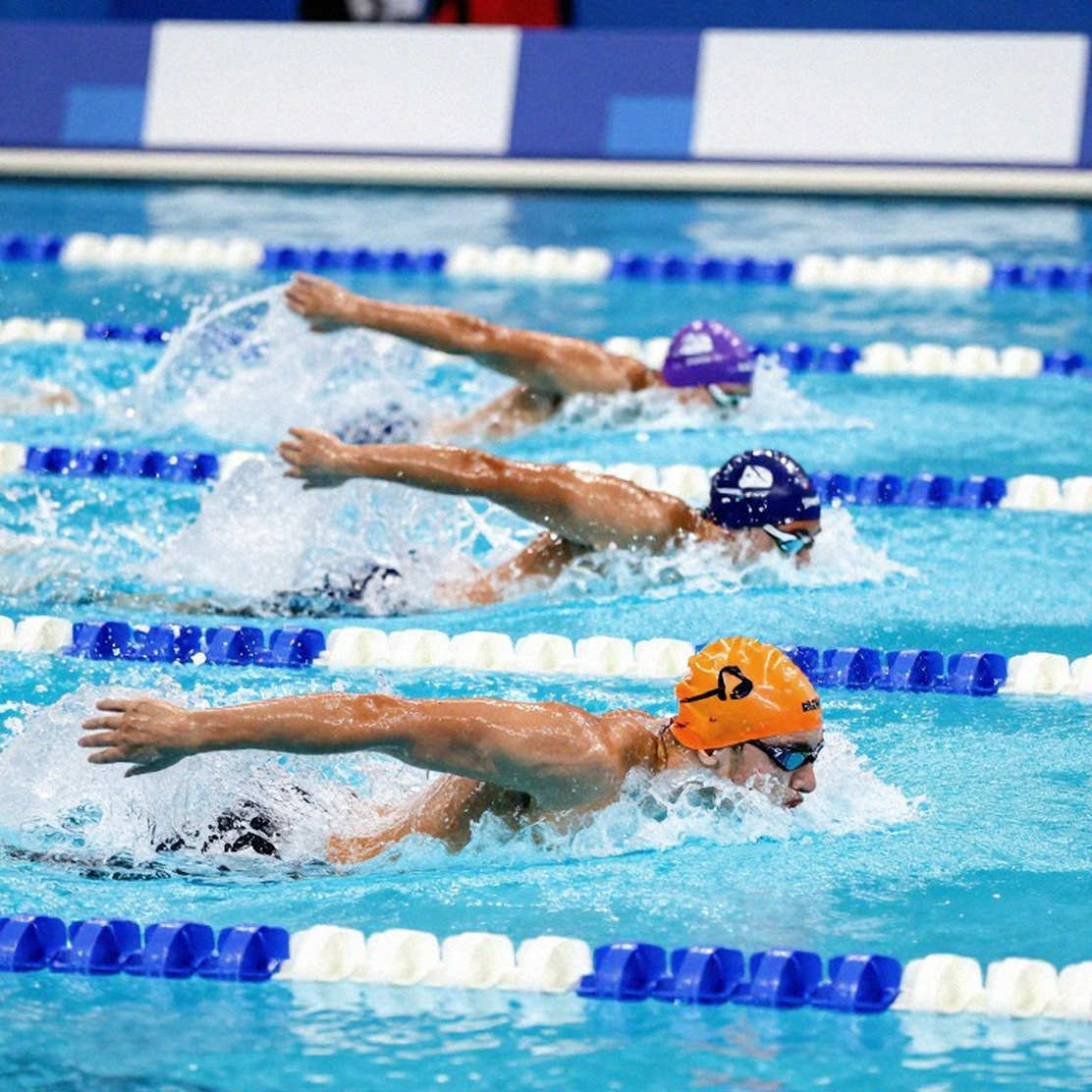
No 50-metre splits. No stroke rate. No 15-metre in and 15-metre out times for each turn. No count of dolphin kicks while the swimmer is still under water. A four-and-a-half-minute race, containing hundreds of technical decisions, is compressed into eight numbers of identical shape.
I once ran an extraction pipeline against a swimming file. The result came back as an empty set: no data points, no entities, no timestamps. The software worked correctly. The input simply held nothing to decompose. For a data person, that is the worst possible result, because it rejects no hypothesis; it only confirms that nobody recorded enough for a hypothesis to exist.
The biggest problem in Vietnamese swimming sits in the data layer beneath the medal, not in the medal itself.
Vietnamese swimming had a decade shaped by one name. Nguyen Thi Anh Vien, born in 2026 in An Giang, collected more than twenty SEA Games gold medals between 2026 and 2026. At the 2026 SEA Games in Singapore she won eight golds. At the 2026 SEA Games in Kuala Lumpur she repeated her dominance across individual medley, backstroke and butterfly. In that stretch, a Vietnamese swimmer appearing on continental results sheets was the default, not the exception.
On the men's side, Nguyen Huy Hoang, born in 2026 in Quang Binh, won silver at the 2026 Asian Games in the 1,500 metres freestyle and kept collecting SEA Games golds in the distance freestyle group. The pair produced a comfortable illusion: Vietnam already had a regional-class swimmer, and the next cohort would arrive automatically.
Between SEA Games editions, most fans track only the final result. In my line of work, the annual season is where the real story happens. The national championship, the youth circuit and internal time trials generate thousands of data points every year. Nearly all of them are lost the moment the scoreboard goes dark.
The right question for the next cycle is not who will win SEA Games gold. It is which layer of the pipeline is leaking, and how we would know before the Games begin.
Five metrics the results board never prints
What does an ordinary viewer want after rewatching a race? They want to know where the winner won it. The results board cannot answer that.
Fifty-metre splits are the segment times. Without them, we do not know whether a swimmer distributed effort quickly or slowly in the first half. A positive split, where the second half is slower, or a negative split, where it is faster, is a direct signal of the fitness model and the tactical choice.
Stroke rate is the number of stroke cycles per minute. It tells us whether a swimmer is speeding up by turning the arms over faster or by lengthening each stroke.
Distance per stroke is the length of each pull. Speed equals stroke rate multiplied by distance per stroke. An equation with only two unknowns, and both go unrecorded at every domestic meet.
The 15-metre in and out times per turn are the start and the turn exit. This is where leading swimming nations manufacture their margins, because underwater technique determines the speed coming off the wall.
The number of dolphin kicks before surfacing is a small technical variable that can create a few tenths of a second per turn. Multiply by eight turns and the error is large enough to change a placing.
An example shows how serious this gets. Suppose a 200 metres individual medley swimmer is 0.8 seconds slower than three months earlier. That equals 0.4 per cent of total time. If the cause is a lower stroke rate, the corrective programme is strength and rhythm work. If the cause is a shorter underwater phase off the turns, the corrective programme is underwater technique and breath control. Two diagnoses lead to two completely different programmes. Without splits, the coach must pick one and hope.
Turning time gaps into probabilities
At the SEA Games, the winning threshold in the men's 1,500 metres freestyle typically sits near 15 minutes. At the Asian Games, a final berth usually falls around 15 minutes 05 to 15 minutes 15. At the Olympics, the threshold drops below 15 minutes. These are reference markers, not fixed truths, because the form of an entire regional generation can push the line up or down by several seconds.
Assume a Vietnamese male swimmer is currently at 15 minutes 30 seconds. To reach an Asian Games final threshold, he must cut 25 seconds from 930 seconds, or 2.7 per cent. That percentage sounds small. At senior level, sustainable improvement is usually only 0.5 to 1 per cent per year, and the rate declines after age 21. The problem becomes a three-to-five-year project, conditional on the swimmer holding training volume and avoiding injury.
This is why I always present projections as probabilities. No swimmer is guaranteed a medal; there is only a swimmer with a specific improvement trajectory, measured against a specific performance threshold, at a specific moment. When those three variables align, the probability rises. When one drifts, it collapses quickly.
Every upset has its own probability. We call it an upset when we have not yet checked the table.
The Nguyen Thi Anh Vien case: a traceable trajectory
What separated Nguyen Thi Anh Vien was not height or arm span. It was that she trained inside a system where every session and every competition left data behind. When a swimmer trains abroad, most of the value received is not the sets. It is the feedback loop. Every morning, the previous afternoon's numbers are already on the board. Errors are caught in hours, not months.
As a result, her career became a curve rather than a collection of anecdotes. You can see the peak, the plateau, the age-driven decline, the accumulated load. To an analyst, that curve is worth more than twenty medals, because it can be extrapolated.
The problem is that the curve was never continued. The young swimmers who emerged after 2026 have no equivalent split-level record. The system learned nothing from the best athlete it ever produced.
An era ends when nobody reads its data tables anymore.
The Nguyen Huy Hoang case: an aerobic engine and a pacing problem
In distance freestyle, results are largely decided before the race starts, in how effort is allocated across segments. Based on my experience watching swimming meets over more than twenty years, a 1,500 metres race at continental level splits into three blocks: the first 400 metres holding rhythm, the middle 600 metres holding position, the last 500 metres deciding the outcome. A swimmer who holds an even rhythm through the middle block gains an advantage in the final block, because rivals forced to lift stroke rate early pay in lactic acid.
Nguyen Huy Hoang's 2026 Asian Games silver sits inside that logic. His aerobic base was deep enough to hold stability across 1,500 metres while rivals in his group faded over the last 300.
But here is the caveat I always impose on myself: every description above rests on eye observation, because split data is not published. A model built by eye carries a far wider confidence interval than one built on numbers. I can say Huy Hoang paced well. I cannot say by what percentage he paced better than his rivals, or exactly where.
The puberty barrier, where the pipeline leaks most
In women's swimming, an athlete's fastest times often arrive between ages 14 and 16, after which performance can plateau or regress through puberty. The physical causes are clear: changes in body composition, height and limb proportions, shoulder torque, and the psychology of training at high intensity inside a changing body.
Without segment-level data tracked across years, the system cannot separate two groups. The first are early maturers who have already reached near their physiological ceiling at 15. The second are late developers, temporarily stalled by bodily change, who will pass their old marks 18 months later. Both groups swim the same time at 15, and have entirely different trajectories after 19.
At many national youth meets, age-group records fall repeatedly and then go silent for years. Every time that happens, the system loses a swimmer without knowing why. Answering that requires longitudinal data: the same swimmer measured against the same metric set for at least five years.
Meet density: the cheapest data source we are wasting
Every timed meet is a data-generating event. A thin domestic calendar produces few data points, and few data points produce weak models. Four to six official time trials a year, each publishing full splits, is enough to build an improvement curve for every swimmer.
The cost of publishing splits is close to zero. The cost of not publishing is very large, because it shifts onto coaches as trial-and-error time, and onto swimmers as years of training in the wrong place.
A-standard and B-standard in selection
An effective practice is to assign two thresholds per event. The A-standard is a time good enough to reach a SEA Games final. The B-standard is a time good enough to contest a medal. A swimmer who hits the B-standard once and the A-standard five times has a fundamentally different profile from one who hits the B-standard once and never repeats it.
Selection probability should attach to how often a threshold is met, not to a single personal best. A single personal best in swimming is one draw of the right card at the right moment. It deserves recognition. It does not deserve to carry an entire Games selection on its own.
The counterintuitive angle
The familiar Vietnamese argument runs like this: successful swimmers succeed because they train abroad, so send more swimmers abroad. The correlation is real, but the mechanism is not obviously the plane ticket. Swimmers who train abroad succeed because they enter a system where every session leaves data behind, and the data returns fast enough that errors are corrected before they harden into habits. Remove the ticket but keep the mechanism and the result is still achievable. Keep the ticket but remove the mechanism and the money is spent while the improvement curve stays flat.
The second factor my model cannot quantify is the crowd. At a Games held at home, the noise of the stands affects competitive psychology and even breathing rhythm, especially in short events. When the Games move abroad, that variable is eliminated. When the stands fall silent, home advantage dissolves into a number close to zero. That share of the variance sits outside every table we currently hold, and I treat it as a confidence interval rather than pretend it has been measured.
Signals for the next cycle
Three indicators will reveal whether Vietnamese swimming is building its data layer. First, the number of domestic meets publishing full splits. Second, the number of swimmers under 16 meeting the A-standard at least three times in a year. Third, how often a young swimmer competes internationally before turning 18.
If all three move upward within two years, the next cycle will offer more than one name to follow. If all three stay flat, every medal projection is just inference from memory.
Ordinary viewers watch the medal to understand a SEA Games. I read the split table to understand the years before it.
A swimming nation does not need more praise. It needs more lines of data. Every time a coach can ask a more specific question about a swimmer, the improvement curve shifts forward by a few per cent. Added up over five years, those percentages are the distance between making a final and standing on the podium.